The Top 10 Med Spa Ads of 2026 (And the Facebook Playbook Behind Them)
Facebook ads changed while nobody was looking. Here's exactly what's working now, when to use it, and the mistakes quietly draining your ad budget.
Meta's AI (Advantage+) now does the targeting — your job is to feed it a lot of good creative and enough conversion data, then get out of the way. The med spas winning in 2026 run broad targeting, UGC-style ads, server-side tracking (CAPI), and let campaigns run untouched for at least 7 days. The ones losing money are still tinkering daily, targeting tiny interest groups, and running one lonely ad and wondering why it's not working.
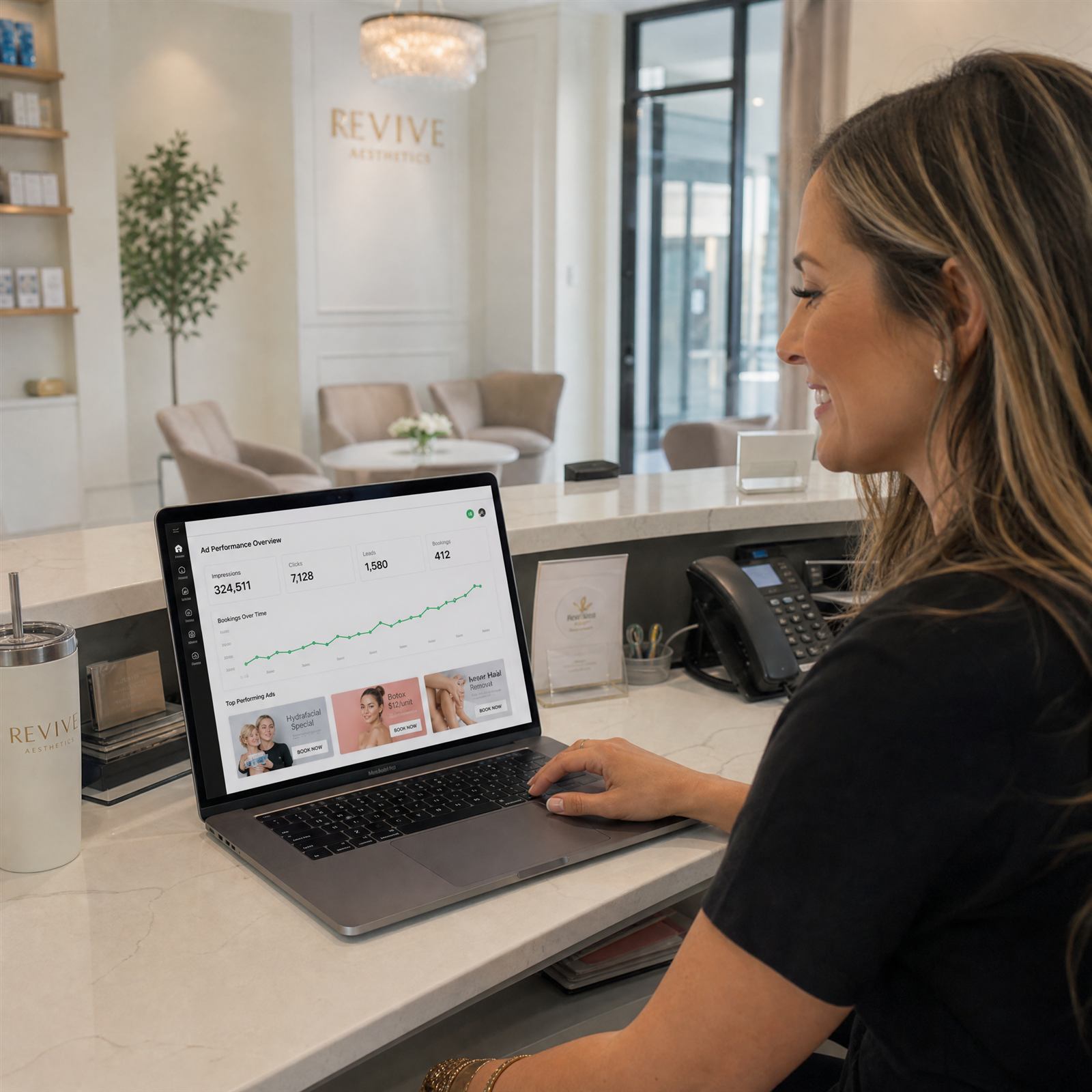
Why Facebook in 2026 is a totally different game
If you're running Facebook ads as you did a couple of years ago, you're throwing money out the window. In 2026, Meta has handed the wheel to Advantage+ Campaigns — its AI-powered ad system.
You no longer pick tiny, specific interests for your audience. Instead, you go broad and let Meta's algorithm look at your ad and find the perfect patients on its own. Here's the part that trips people up: your creative ad is now your targeting. If your ad is good, the AI finds the patients. If your ad is boring, you lose money — no amount of clever interest-stacking will save it.
The top 10 med spa ads of 2026
Here's the winning list, and exactly why the 2026 algorithm rewards each one.
| Ad Format | Why It Works |
|---|---|
| UGC review clips | Real patients talking on camera keep you clear of Meta's strict personal-attribute policies — old-school before/after photos get flagged far more often. |
| "What to expect" POV videos | Short-form video is exactly what Reels and Stories were built for, and the algorithm pushes cheap views toward it. |
| Local micro-influencer seeding | Highly engaged local creators build trust that reads as native social proof rather than an ad. |
| Injectable + facial combo offers | A strong bundled offer stops the scroll and gives Facebook a clear signal about who's actually ready to buy. |
| Qualifying lead forms (2–3 questions) | Quality over quantity — it teaches Facebook exactly who your true VIP patient looks like. |
| Full four-stage funnel | Warm retargeting converts far faster than cold traffic, which helps you hit the 50 conversions Meta needs to exit the learning phase. |
| "Provider selection" retargeting | Catch people who just clicked a competitor's ad — they've already decided they want the treatment; they're just choosing who to get it from. |
| GLP-1 entry ad (weight loss) | A massive hook right now — but Meta's Advertising Standards require weight-loss ads to be restricted to age 18+. Set the age gate or risk a disapproval. |
| Advertise the guarantee | Leading with a unique offer structure (like pay-per-attended-consult) is a genuinely fresh hook, and Meta's AI rewards angles nobody else is running. |
| Brand-mention seeding | Word-of-mouth on Reddit and local forums feeds organic social proof, which makes every paid ad on top of it perform better. |
The marketing agency "must-haves"
To make those 10 ad formats actually work, whoever runs your account needs to be doing two things without fail.
Server-side tracking (CAPI). Web browsers and iPhones now block tracking cookies by default. If your agency is still relying solely on the old Facebook Pixel, you're flying blind. The Conversions API (CAPI) sends data directly from your website's server to Meta's server — completely bypassing ad blockers and providing far more accurate data.
1% lookalike audiences & exclusions. Upload your best patients, and Meta will build a "1% Lookalike" audience — thousands of locals who behave just like your best customers already do. Just as important: exclude your existing patients from new-patient campaigns, or you'll pay to show ads to people who already love you.
The best campaign & carousel build-up
For a winning setup, group your best ads together instead of scattering your budget.
- Campaign Budget Optimization (CBO): put all your money at the top of the campaign and let Facebook divide it across ad sets — one for your Lookalike audience, one for a totally broad audience.
- Carousels: each swipeable card carries its own hook, multiplying the number of angles a single ad can test.
- Dynamic Creative: load 3 to 5 images, 3 to 5 headlines, and 3 to 5 text options, and let Facebook's AI mix and match them like a puzzle until it finds the winning combination for each viewer.
"If you have the data, let the AI do the heavy lifting with Advantage+. But no matter what, your creative video is your best targeting tool — and giving the system time to learn is the only way to win."
3 case scenarios: what to use, and when
Facebook ads can feel like defusing a bomb blindfolded — until you know exactly when to reach for which tool. Here are three real-world med spa situations, and exactly what to do in each one.

The situation: Dr. Glow just opened her brand-new med spa. Her Facebook pixel is a ghost town, she's got a few hundred dollars to spend, and exactly two good videos of herself doing lip filler.
The mistake: She hears "Advantage+" is the hot new AI thing and flips it on immediately. The AI panics because it has no idea who her patients are yet, and burns through her budget guessing.
The fix: Stay in manual mode. When your account is brand new with limited conversion data and fewer than 5 ads to test, build a manual audience of 1 million to 10 million people to give the algorithm a solid starting point, and set a manual ad set budget so you control spend while the system learns. Keep doing this until you hit the magic number: 50 conversions a week.
The situation: Nurse Nancy's med spa is crushing it — 50+ bookings a week, over $2,000 a month in ad spend, and a phone full of great patient review videos.
The mistake: She's still manually guessing at interests like "skincare" or "luxury goods," which quietly caps her own reach.
The fix: Time to unleash Advantage+ Shopping Campaigns. Leave targeting completely broad — no interests — and let the AI find the buyers. The secret weapon: set an Existing Customer Budget Cap of 20–30%, forcing Facebook to spend 70–80% of the budget hunting brand-new patients instead of re-showing ads to people who already visit her clinic.
The situation: Clinic owner Carl launches a great campaign. Day 1, costs are high. Day 2, still high. Carl panics, changes the budget by 50%, and swaps the video. A month later, the ads are finally working — then they suddenly stop getting clicks for four straight days. Carl panics again.
The fix, part one — the learning phase: A new ad needs about 50 actions to figure out the math. Don't touch it for at least 7 days. Changing the budget by more than 20% or swapping the creative resets the learning clock to zero.
The fix, part two — ad fatigue: If ads have been crushing it for weeks and you suddenly see a 3–4 day streak of rising costs and falling bookings, that's fatigue — people are just tired of the same video. Don't touch the campaign settings. Instead, film 30 new ads: 70% close remakes of the winning video, 20% same message in a different style (a whiteboard explainer instead of a talking head), and 10% completely new, wild ideas. Drop those in and watch bookings climb again.
DeployStaff runs Advantage+, CAPI, and creative testing for med spas so you're not guessing which scenario you're in.
Get a Free Campaign PlanFlat fee, no long-term contracts. See our med spa marketing service.
Top 5 mistakes that burn your budget
If you want to torch your ad budget in record time, do these five things. If you want to be profitable, avoid them like the plague.
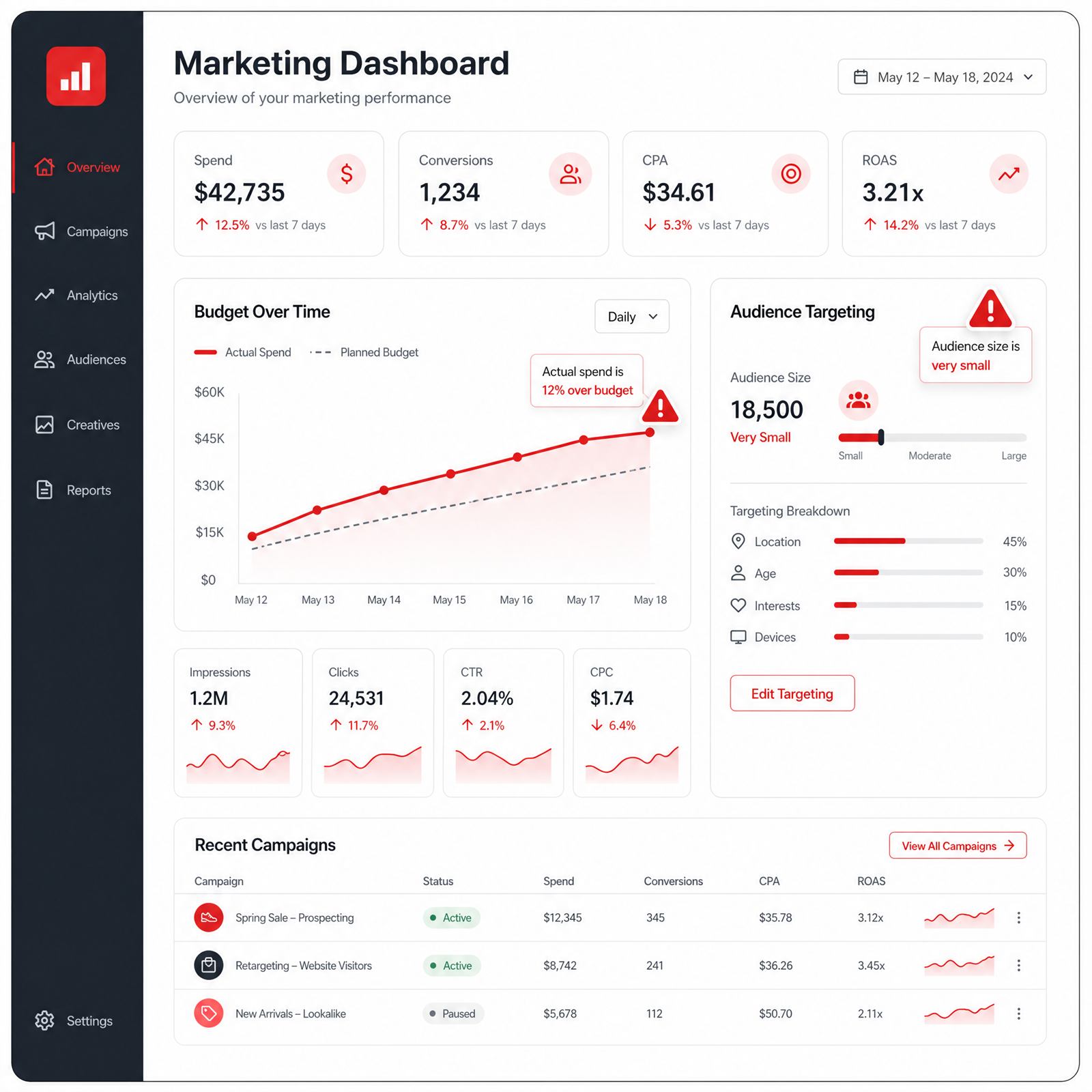
- Paying to "win back" your own best friends. Without an Existing Customer Budget Cap, Advantage+ takes the lazy route by spending your money on re-showing ads to people who already visit your clinic. Cap existing-customer spend at 20–30% and force the AI to hunt for new patients.
- Falling into the "Tinkerer" trap. Checking your ads daily, changing the budget by more than 20%, or swapping creative resets the learning phase clock to zero. The algorithm needs roughly 50 real actions to learn — keep your hands off the keyboard for 7 to 14 days.
- Starving the AI with boring, lonely ads. One or two ads gives Advantage+ nothing to work with. Load 5 to 10 genuinely different creative variations — some top agencies run 20 to 30 in a single ad set.
- Using 2019 "interest" targeting. Hyper-specific targeting like "people who like luxury skincare in a 5-mile radius" throws away reach. In 2026, broad targeting wins — leave interests blank and let a strong video attract the right buyers.
- Flying blind with broken server-side tracking. The old Pixel is dying as browsers block third-party cookies. You need CAPI — and it needs proper Event Deduplication, or Meta will count the same patient twice and wreck your data.
Top 5 questions to ask your marketer
Before handing over your credit card, ask these exact questions to find out if your marketer actually knows how Meta works in 2026.
- "Are you setting an Existing Customer Budget Cap on our Advantage+ campaigns?" If they ask "what's that?" — run. It should sit at 20–30% so most of your budget goes toward brand-new patients.
- "How are you handling CAPI and event deduplication?" They need to send events from both the browser and the server, each tagged with a unique Event ID, so Facebook doesn't count the same booking twice.
- "What is our Event Match Quality (EMQ) score right now?" This is Meta's grade, out of 10, for your tracking setup. Below 6.0 means sloppy tracking and ads that can't find the right buyers.
- "How many conversions are we getting per week, and are we exiting the learning phase?" Meta needs roughly 50 conversions at the ad set level. If the budget's too small for that on bookings alone, ask whether they're optimizing toward an earlier step like "Add to Cart" or "Initiate Checkout" to keep the AI fed.
- "What's your creative testing strategy, and how many ads are we running?" Manual targeting is mostly dead — your creative is the targeting now. If they're only running one or two ads, they're setting you up to fail.
Frequently Asked Questions
Get a free campaign plan built around your account's actual data — not a generic playbook.
Get a Free Campaign Plan$95/week per channel. See how it works.
DeployStaff runs flat-fee Meta and Google Ads campaigns for med spas, roofers, dentists, and restaurants — built around whatever the current platform algorithm actually rewards, not what worked two years ago.