GEO vs. SEO: What's Actually Different (And Why It Matters for Small Business)
A story about a bakery, a hardware store, and the quiet shift happening in how customers actually find you now.
SEO gets your website ranked on Google. GEO (Generative Engine Optimization) gets your business cited directly inside AI answers from tools like ChatGPT, Perplexity, and Google's AI Overviews. You still need SEO's technical foundation so AI bots can read your site — but GEO is what decides whether they actually quote you.
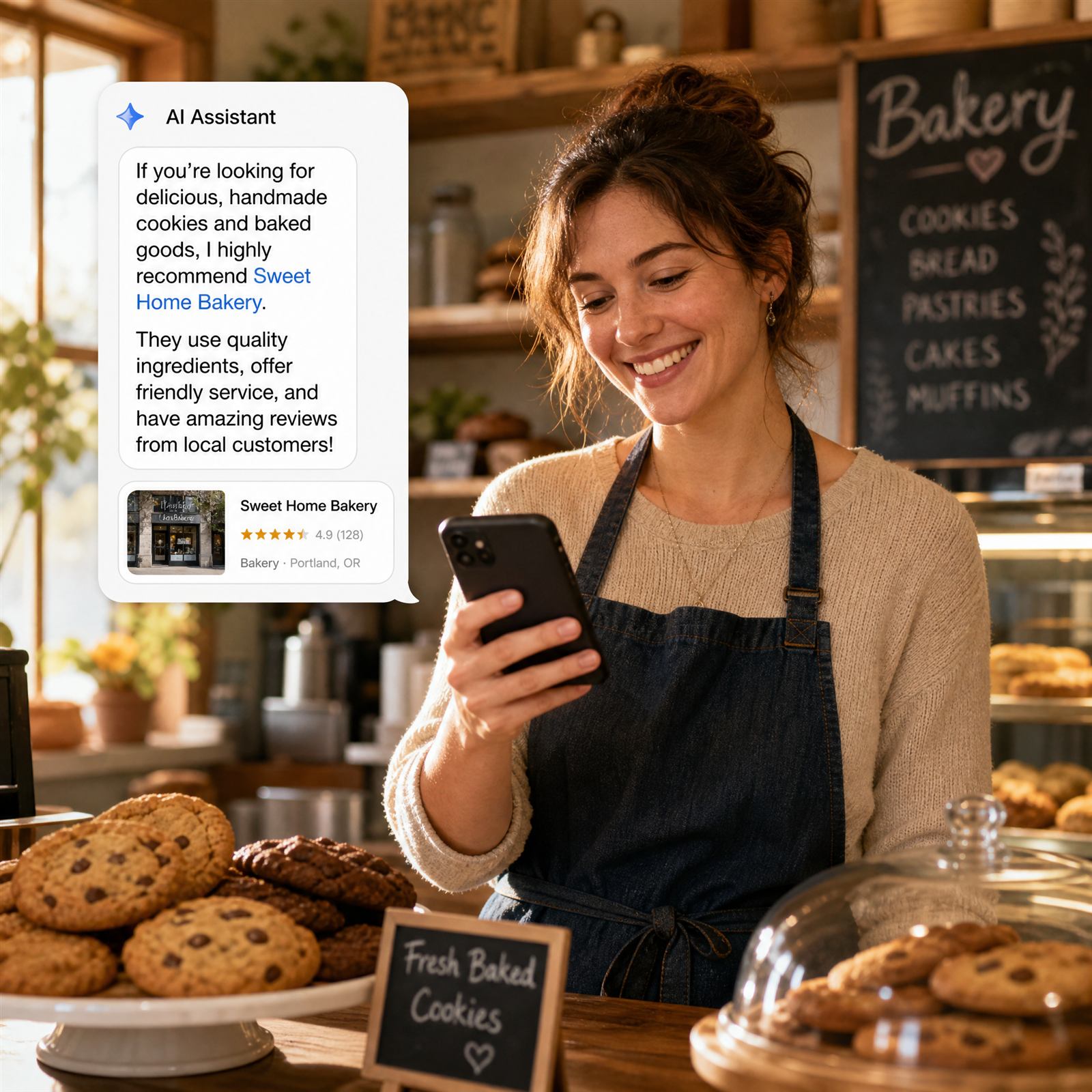
Imagine you own a small, local bakery called Sarah's Sweets. For the last ten years, whenever you wanted to attract new customers online, you played by a very specific set of rules. You figured out exactly what words people were typing into Google — things like "best chocolate chip cookies near me" — and you optimized your website's pages to match those exact phrases. You worked hard to get other websites to link back to yours to build "authority." When everything went right, your bakery showed up as one of the top blue links on Google's results page.
That game has a name: SEO, or Search Engine Optimization. Its whole job is to rank your website in a list and earn a click.
But fast forward to today. A customer doesn't just search Google for a list of links anymore. They pull out their phone and ask an AI assistant — ChatGPT, Perplexity, Google's AI Overviews — a highly specific question: "Where can I find a bakery downtown that has vegan chocolate chip cookies, free Wi-Fi, and is open right now?"
The AI doesn't hand the customer a list of blue links to click through. It reads the internet, pulls the facts together, and writes a complete, personal answer: "You should check out Sarah's Sweets. They bake fresh vegan chocolate chip cookies every morning, offer high-speed Wi-Fi, and stay open until 8 PM."
Sarah didn't just rank on a page. She was quoted. She was the answer.
That new frontier has a name too: GEO, or Generative Engine Optimization. This is the story of what GEO actually is, how it's different from SEO, why the two need each other, and why this shift might be the best thing to happen to small brick-and-mortar businesses in years.
What is SEO? (The foundation)
To understand where things are going, it helps to respect where they started. SEO is the practice of optimizing a web page to rank higher in traditional search engines like Google or Bing.
- The unit of optimization: a whole page, built around one specific search query.
- The goal: earning a click. You want your blue link to look appealing enough to get someone to visit your site.
- The strategy: classic SEO leans on repeating your target phrase across the page, publishing long-form content, and collecting backlinks — other sites linking to yours as a kind of vote of confidence.
An SEO example: A local plumber writes a 2,000-word blog post titled "Emergency Plumber Chicago" and pays a few directories to link back to his site, hoping Google decides he's authoritative enough for the #1 spot.
What is GEO? (The next layer)
GEO stands for Generative Engine Optimization — a term formalized in a 2024 academic paper from researchers at Princeton, Georgia Tech, and the Allen Institute for AI. GEO is the practice of shaping your content so it gets retrieved, trusted, and cited within an AI-generated answer, rather than just being listed as a link.
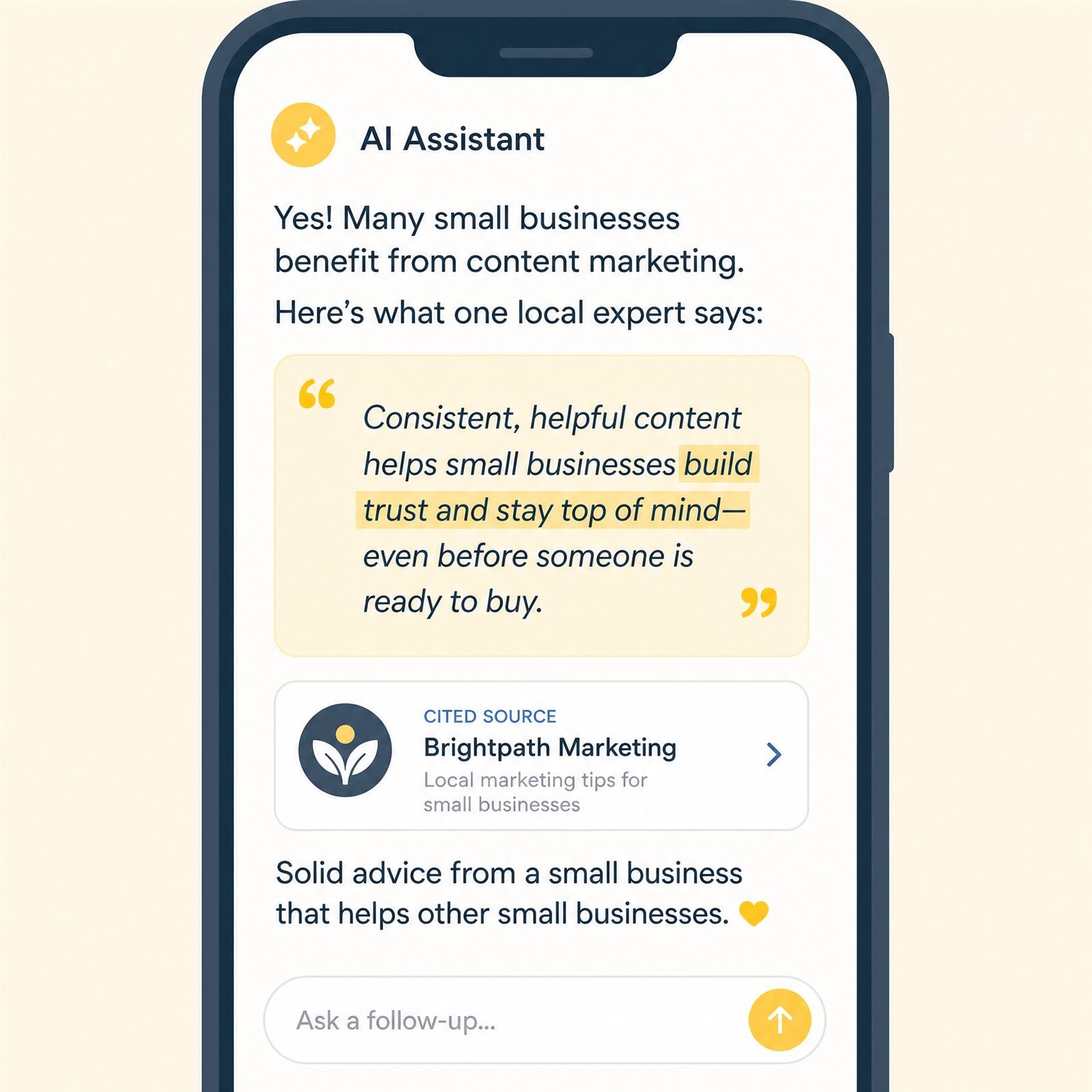
- The unit of optimization: not a whole page, but a single passage or answer block — something clean enough to be lifted out and cited as a fact.
- The goal: getting cited. You want the AI to read your site, trust what it says, and use your business as its source.
- The strategy: AI models learn from the text itself, not just from who links to whom. So GEO leans on specific statistics, credible sources, and brand mentions — real people talking about your business across the web — rather than backlinks alone.
A GEO example: That same plumber rewrites part of his site into a clean, answer-shaped section: "What is our emergency response time? We average 45 minutes for emergency calls in downtown Chicago." Backed by a real number, it's the kind of sentence an AI can lift straight into its answer — and it does.
SEO vs. GEO: what's actually different
They sound like cousins, but some of the tactics that win at SEO can actively hurt you at GEO.
| Signal | Effect on AI visibility |
|---|---|
| Keyword stuffing | Hurts you — tested across 10,000 queries, it made pages less likely to be cited, not more. |
| Adding real statistics | Helps you — quantitative, verifiable stats measurably improved AI visibility in the same study. |
| Backlinks alone | Weaker signal for AI engines than it is for classic Google rankings. |
| Brand mentions (reviews, forums, Reddit) | Correlates more strongly with AI citation than backlinks do, per 2026 industry research. |
Keyword stuffing hurts you now. The researchers who coined GEO tested 10,000 queries and found that keyword stuffing — the oldest trick in the SEO playbook — actively worsens your visibility in AI engines. AI engines prefer natural-sounding language, not robotic repetition.
Statistics beat fluff. Adding relevant quantitative statistics to your content has been shown to meaningfully boost AI visibility in the same study. AI engines are hungry for facts they can verify and quote.
Brand mentions beat backlinks. A 2026 industry study found brand mentions correlate far more strongly with AI visibility than traditional backlinks. AI models pay attention when your business name comes up naturally in reviews, on Reddit, and in community forums — not just when a blog somewhere links to you.
How SEO and GEO work together
So should you throw your SEO strategy out the window? No. GEO isn't a replacement for SEO — it's a new layer built on top of it.
Before an AI engine like ChatGPT or Google's AI Overviews can cite your business, it has to be able to read your website. If your site isn't crawlable and indexable — the most basic fundamentals of SEO — there's nothing for the AI to find.
That means checking your robots.txt file to make sure the right bots are actually allowed in: OAI-SearchBot so ChatGPT can search your site, PerplexityBot for Perplexity, and Google-Extended for Gemini and AI Overviews.
"If SEO is the foundation of the house, GEO is the interior design that makes the AI want to move in. You need technical SEO to open the door, and GEO to hand it exactly what it needs to answer the question."
The ultimate equalizer for small business
For years, SEO was an unfair game. A small, independent shop simply couldn't outspend a national chain that was pouring millions into backlinks and ranking tricks.
GEO changes that math. Because generative engines care about what a page actually says rather than how many links point to a domain, a smaller, clearer, more honest website can suddenly leapfrog a giant one. The academic study behind GEO found that adding authoritative citations and statistics meaningfully boosted visibility for lower-ranked websites, while top-ranked sites that relied solely on old SEO tricks actually saw their AI visibility drop.
If you run a bakery, a hardware store, or a boutique, you don't need a massive marketing budget to win at GEO. You need the clearest, most factual, easiest-to-read answers to the exact questions your customers are already asking.
Case scenario: the hardware store hero

A giant big-box competitor currently ranks #1 on Google for "paint supplies" — thanks to thousands of backlinks and a massive site. Joe's Local Hardware sits quietly on page 3. So Joe decides to try GEO instead of fighting the same losing battle.
- Restructuring for AI: instead of long, rambling paragraphs about paint, Joe writes answer-shaped sections. A question as the header — "What brands of eco-friendly paint do we carry?" — followed immediately by a plain answer: "Joe's Local Hardware carries 4 brands of eco-friendly, zero-VOC paint: Brand A, Brand B, Brand C, and Brand D."
- Adding real numbers: "We stock over 500 custom paint colours and offer a 5-minute colour-matching guarantee."
- Schema markup: structured data (JSON-LD) that specifies his location, hours, and services in a format that machines can read directly.
- Brand mentions: Joe encourages happy regulars to mention "Joe's Local Hardware" by name in local Facebook groups and on Reddit.
The result: A local resident asks ChatGPT, "I need zero-VOC paint matched to a custom colour quickly, where should I go?" The AI skips past the big-box site's maze of keyword fluff and pulls Joe's clean, structured answer instead: "You should go to Joe's Local Hardware. They carry 4 brands of zero-VOC paint and offer a 5-minute custom colour-matching guarantee."
Joe just beat a multi-million-dollar corporation by doing one thing: structuring his facts so that an AI could actually read them.
DeployStaff builds GEO into your site from the ground up — with structured answers, real citations, and the technical SEO that supports it.
Get a Free Campaign PlanCurious what this looks like for your business? See our AI Search Optimization service.
Test Your Knowledge: The GEO Mastery Quiz
Tap a question to reveal the answer.
Frequently Asked Questions
Get a free, no-pressure campaign plan built around how your business shows up in AI search.
Get a Free Campaign PlanFlat fee. No long-term contracts. See how it works.
DeployStaff builds AI search visibility and paid media systems for local service businesses — flat-fee PPC, GEO/AI search optimization, and AI-powered booking.