ChatGPT Ads Explained: The Complete Guide (2026)
What ChatGPT Ads are, how context-hint targeting and bidding work, who's eligible, and how to launch your first campaign. Verified against OpenAI documentation.
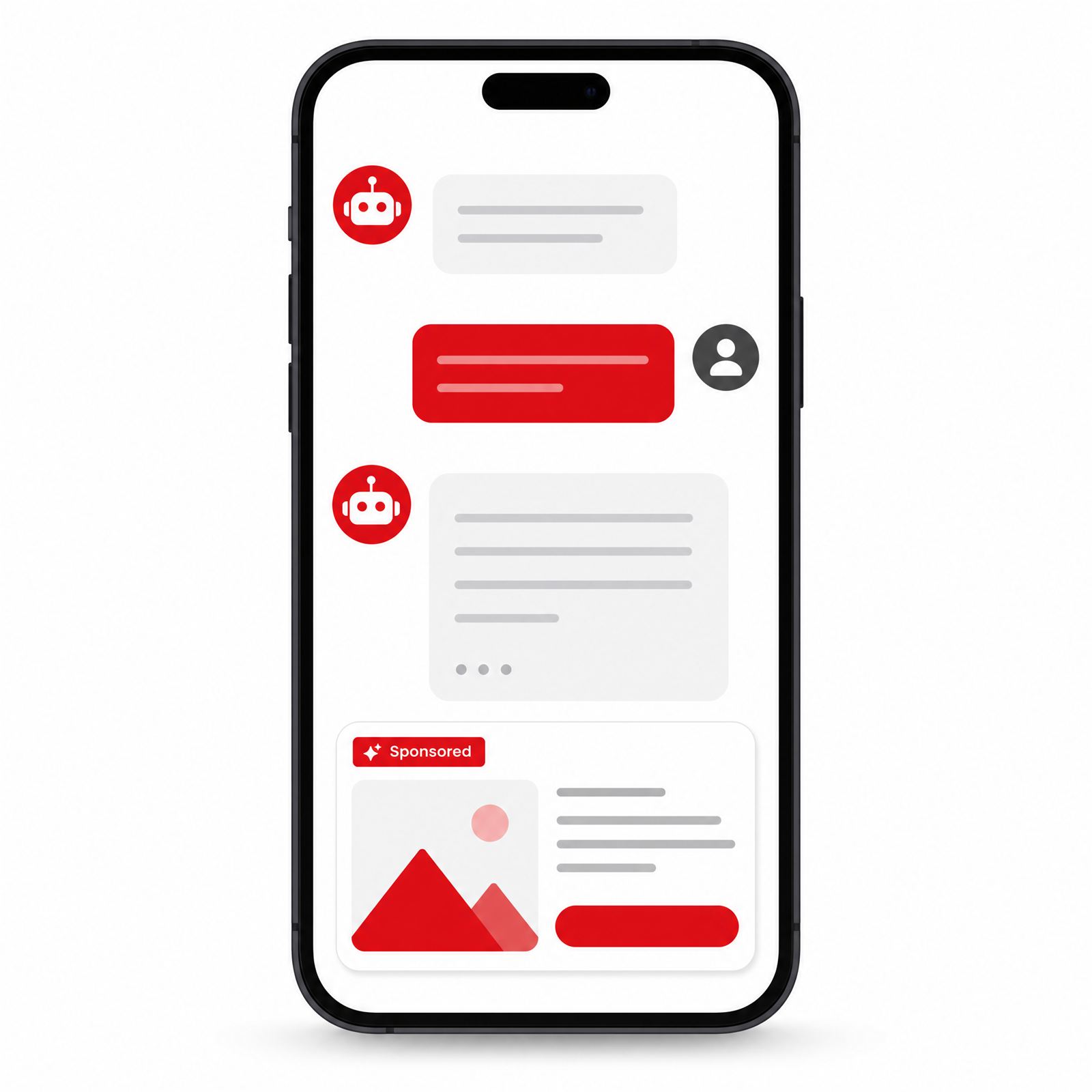
The businesses that jumped on SEO early captured massive market share for pennies while competitors were still figuring out how search engines worked. Right now, you have the same window with ChatGPT Ads. This guide covers everything the platform's documentation actually says about using it.
ChatGPT Ads are sponsored, contextual text placements that appear at the bottom of AI-generated chat responses. They're served exclusively to logged-in adult users (18+) on OpenAI's Free and $8/month Go tiers. The self-serve Ads Manager Beta is currently available to businesses in the US, Canada, Australia, New Zealand, Japan, and South Korea. Eligible categories include local services, consumer goods, digital products, and travel, while regulated spaces like healthcare, politics, and finance are prohibited.
- No keywords. ChatGPT doesn't use keyword bidding. It matches ads to conversations using "context hints."
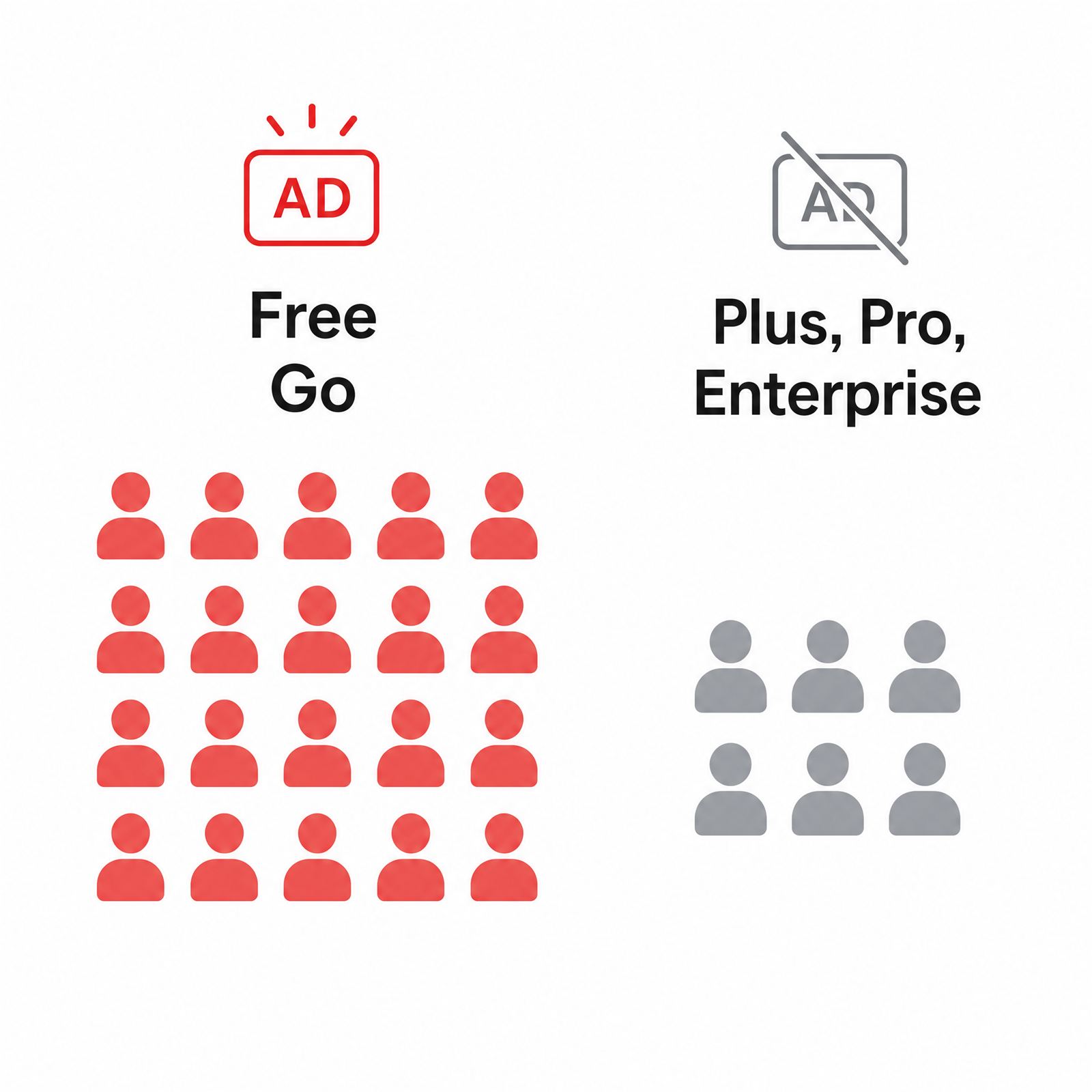
- Strict audience. Ads only show on Free and Go tiers. Plus, Pro, Enterprise, and Edu users never see them.
- High costs, high intent. A relevance-weighted second-price auction with CPCs of roughly $2.50 to $8.00 by category.
- Privacy first. Advertisers never see chat histories or personal data. All reporting is aggregated.
- Organic matters. Paid ads compound when your brand is also cited organically in AI answers (AEO/GEO).
But before you rush to add a credit card, you need to know who's actually seeing these ads. The audience is narrower, and younger, than most business owners expect.
Where and how ads are shown to users
ChatGPT Ads don't look like cluttered banners. They're clean, static ad cards, physically separated at the bottom of a chat response and clearly labeled "Sponsored."
You're not advertising to everyone, though. Ads are hidden entirely from Plus, Pro, Business, Enterprise, and Edu subscribers, and accounts predicted to be under 18 are excluded from targeting. That leaves logged-in adults on the Free or $8/month Go tier.
Statistically, this audience skews young: nearly half of all messages on the platform come from users under 26, and 58% of adult users on consumer plans are under 30. (directly sourced — OpenAI docs) If you sell retirement planning, this may not be the right platform for you. If you sell software, consumer goods, or local services, it's a strong match.
Reaching that audience starts with getting into the platform at all. The verification process has a trap that catches many agencies off guard.
How the ad platform works
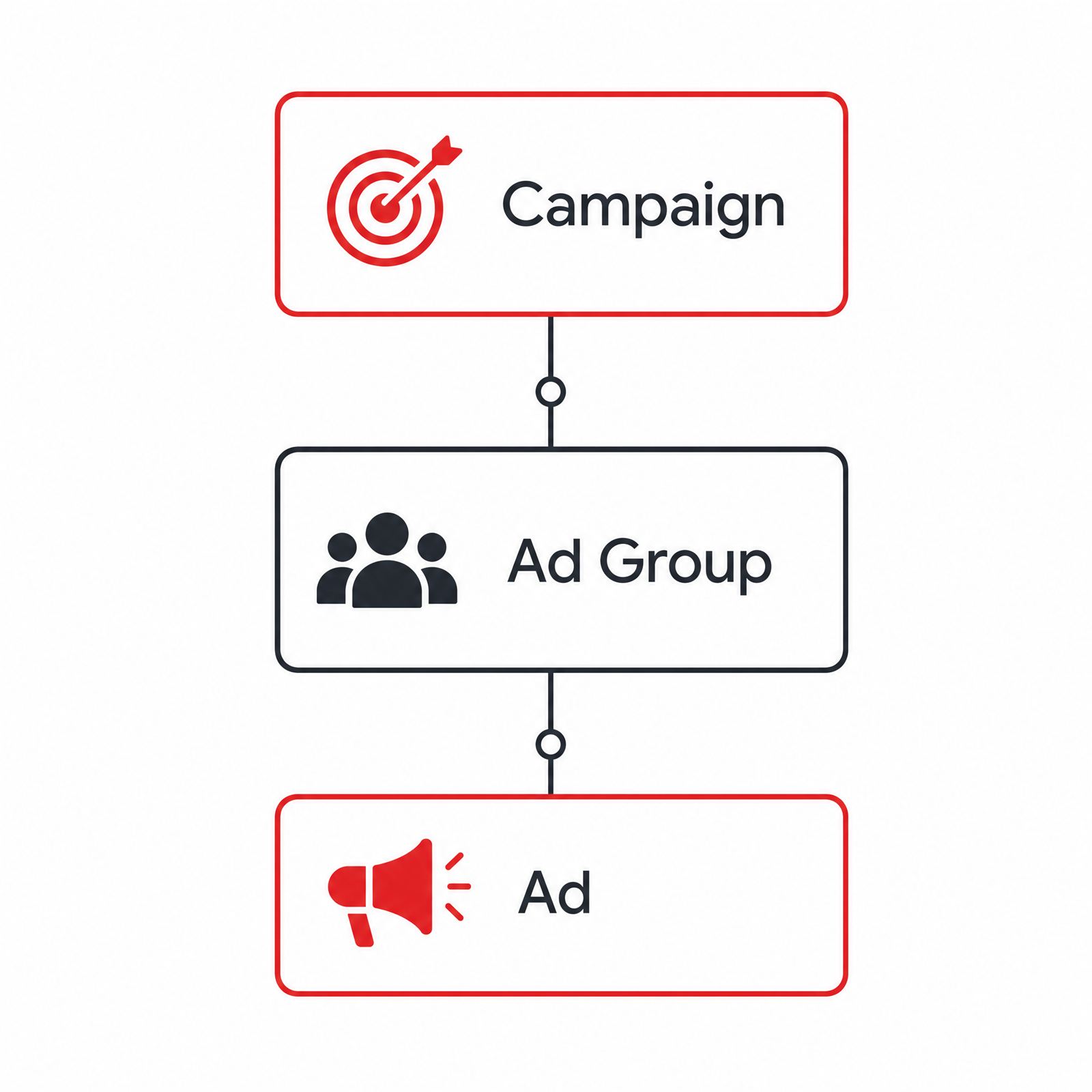
OpenAI's Ads Manager Beta follows a familiar hierarchy: Campaign → Ad Group → Ad. Getting in takes patience, though.
Setup begins at ads.openai.com with your legal business name, address, website, and tax identifier (an EIN in the US). Verification is handled manually by a third-party vendor, Persona, which runs sanctions checks. Approval usually takes a few business days.
Here's the trap: during setup, you must declare whether your business is an agency, and OpenAI warns this setting cannot be changed later. Select carefully. Once verified, set up your billing profile before any campaign can go live.
One more adjustment for new advertisers: there's no real-time data. The platform has an intentional reporting delay of up to 7 hours between ad delivery and dashboard metrics.
Once you're verified and inside, the next question is how you find customers without keywords. The answer is a genuinely new targeting mechanism.
How targeting works
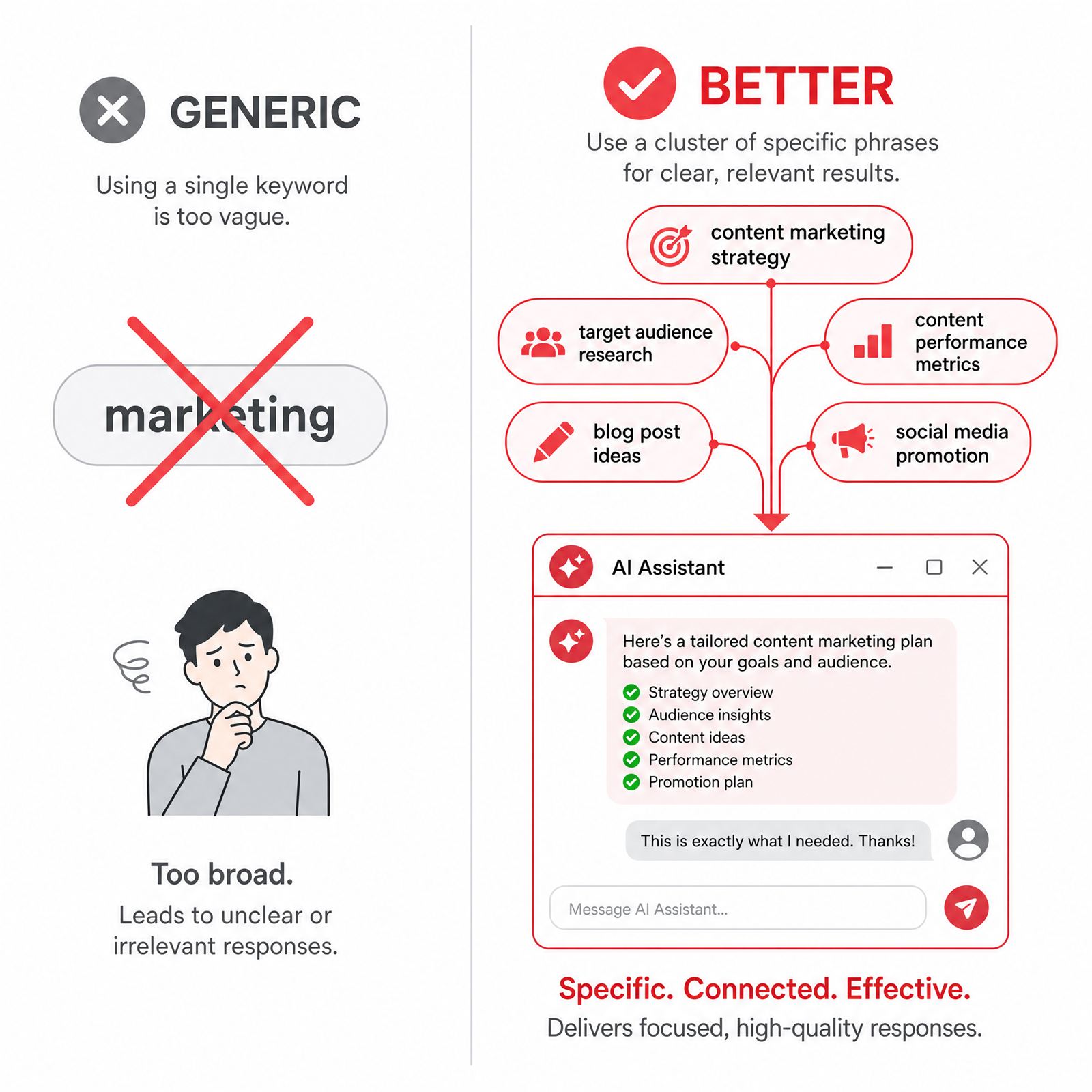
Forget keyword lists. ChatGPT Ads use contextual targeting powered by context hints: short phrases describing the topics, intents, or conversation types where your product is relevant.
If you sell accounting software, you don't bid on "accounting." You write 5 to 10 specific hints per ad group, such as "small business accounting," "tax preparation," and "QuickBooks alternatives." The model weighs them against your landing page and the live chat thread to decide whether your ad is a relevant match.
OpenAI has also added Custom Audiences: upload customer lists of 25,000 or more users to include, suppress, or bid-adjust. A SaaS company can suppress current subscribers from prospecting ads, or apply a bid multiplier to lapsed customers.
Geographic targeting launched in the US, Canada, Australia, and New Zealand and has since expanded to Japan and South Korea.
So targeting is solved. But how much does this cost? ChatGPT Ads are not playing in the penny-click sandbox.
How pricing and bidding work
OpenAI previously required a $200,000 minimum commitment. That barrier dropped when the self-serve Beta opened in May 2026. There's no official platform minimum today, though a testing budget of $50 to $100 per day is recommended to gather enough volume in the first weeks. (practitioner convention)
Two buying objectives exist:
- Reach (CPM): default maximum bid $60; some auctions clear as low as $25. (directly sourced)
- Clicks (CPC): a starting max bid of $3 to $5 is recommended for delivery. (practitioner convention)
Bid $0.30 hoping for cheap traffic, and the system warns you the bid is too low. The ad simply won't deliver. The auction is relevance-weighted second-price: a highly relevant ad with a lower bid can beat a poorly matched ad with a higher bid. CPA bidding is on the roadmap but not yet available.
Budget sorted. But is your business even allowed through the front door? OpenAI's gatekeepers are strict right now.
Who is eligible and what categories are restricted
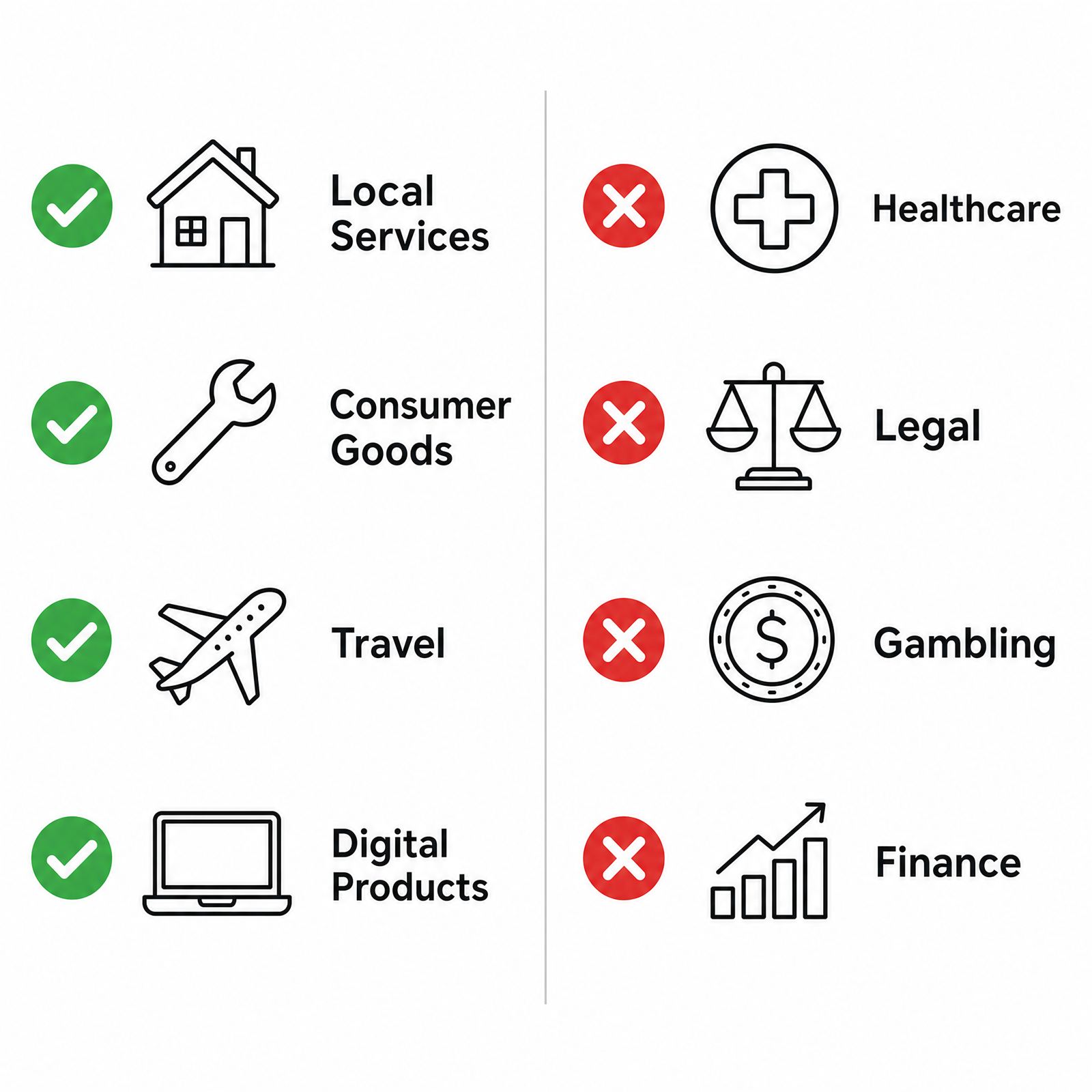
OpenAI is proceeding cautiously to protect user safety and brand suitability. Ads never appear beside harmful, controversial, or sensitive emotional conversations, such as mental health discussions.
Restricted: healthcare, mental health, politics, dating, alcohol, tobacco, gambling, financial services, and legal services cannot advertise.
Eligible: household and consumer goods, local services, travel and experiences, and digital products and education are cleared.
If you clear eligibility, the next question is strategic: how does this fit alongside the ad platforms you already run?
How ChatGPT Ads differ from Google and Meta
Intent vs. demographics. Meta interrupts based on demographics and interests. Google responds to search queries. ChatGPT responds to conversational context: a user midway through a deep, multi-prompt problem-solving session. Your ad arrives as the final solution to that journey.
Privacy and tracking. Advertisers get no chat histories, no memories, and no personally identifiable information. Only aggregated data.
Answer Engine Optimization. On Google, your ad sits above the results. On ChatGPT, your ad sits below an AI-generated answer. If that answer recommends your competitor, your ad looks like an afterthought. Paid placement performs best when your brand is also being cited organically, which is exactly what our AI Search Optimization service builds. Run both, and they compound.
Theory covered. Here's the launch sequence, step by step.
How to get started
- Prepare your assets. A square logo (favicon) of at least 256×256 pixels displays on the ad unit.
- Write to the limits. Titles: 16–24 characters. Descriptions: 32–48 characters. Hard ceilings.
- Build the ad group. Cluster 5 to 10 highly specific context hints.
- Set up UTM tracking. Reporting is delayed, so append UTM parameters (e.g.,
?utm_source=chatgpt.com&utm_medium=cpc) and monitor GA4 directly. - Install conversion tracking. OpenAI's JavaScript pixel, or their Conversions API for backend events.
- E-commerce feeds. Product feeds of up to 2 million items are uploaded via SFTP as CSV, using Google Merchant Center attributes plus OpenAI-specific columns such as
seller_name,iseligible_search, andiseligible_checkout.
Three scenarios: what this looks like in practice
A roofing company runs a Clicks campaign with context hints such as "roof repair after storm" and "local roofing contractor." At a $4.00 CPC (directly sourced), 500 clicks producing 25 qualified leads (synthesis) works out to an $80 cost per lead (synthesis). Home services are an allowed category, and conversational context delivers high-intent traffic (benchmark-observed).
A med spa tries to launch ads for Botox and laser hair removal with a $100 daily budget. Result: zero impressions and zero spend. The account is flagged with a brand review rejection (benchmark-observed). Healthcare is prohibited. The smart move: shift that budget to earning organic AI citations through AI search optimization instead (synthesis).
An invoicing software company uploads a Custom Audience of 30,000 churned users to exclude them (directly sourced — feature). With a $30,000 monthly budget (synthesis) at ~$25 CPM (benchmark-observed) and $5.50 CPC (directly sourced range), spend focuses purely on new prospects: founders asking ChatGPT for accounting workflow solutions (synthesis).
Dos and don'ts
| Do This | Don't Do This |
|---|---|
| Group 5 to 10 specific context hints per ad group to guide the AI. | Don't use broad, single-word keywords the way you would on Google or older ad platforms. |
| Start bids at $3.00 to $5.00 for reliable auction delivery. | Don't bid $0.50 expecting cheap traffic. The system won't deliver. |
| Wait at least 7 hours before judging dashboard numbers. | Don't panic-pause campaigns because day one reads zero. |
| Write to the hard limits: 16–24 character titles, 32–48 character descriptions. | Don't write long persuasive copy. It gets rejected instantly. |
| Pair paid ads with an organic AEO/GEO strategy. | Don't assume an ad converts while the AI recommends your competitor above it. |
| Upload Custom Audiences of 25,000+ to suppress or target. | Don't expect user-level PII reporting. Privacy is strict. |
Self-check quiz: is your business ready for ChatGPT Ads?
- 1. Is your business in an eligible category? Retail, SaaS, local services: yes. Healthcare, finance, politics: no.
- 2. Comfortable with $50 to $100 per day for testing? There's no hard minimum, but less won't generate enough data to optimize.
- 3. Can you state your value in under 48 characters? You must. The description ceiling is hard.
- 4. E-commerce: can your team handle SFTP CSV feeds? No simple plugin integrations exist yet.
- 5. Is your target demographic under 30? If yes, you're in the sweet spot. 58% of adult consumer-plan users are.
Scored 4–5 yes? You're a strong candidate. Not sure? We'll check your GA4 data and tell you honestly. Get a free campaign plan.
FAQ
What to do next
Start by auditing your brand's organic visibility on ChatGPT. Ask it the questions your customers would ask and see who gets recommended. Then, if your category is eligible, apply for Ads Manager verification so the approval days pass while you plan your first campaign. Early platforms reward early operators (practitioner convention), and the businesses building context-hint expertise now will be the ones with the data advantage later.
DeployStaff manages ChatGPT Ads for $95/week. Get your free campaign plan →
This guide is verified against OpenAI's official ChatGPT Ads documentation as of July 2026 and re-verified quarterly. Platform features change frequently. Always confirm current specs at ads.openai.com. Labels used: directly sourced (OpenAI docs) · benchmark-observed · practitioner convention · synthesis.
DeployStaff runs flat-fee Google and Meta Ads for roofers, HVAC companies, dental practices, and med spas — while building the SEO and AI search visibility that lowers cost per lead over time.